
TRENDING
NAACP boycott call challenges Black athletes to act amid anti-Black assaults
5 minutes reading View : 46

Politics - 22 May 2026
Six years after the nation underwent a so-called “racial reckoning,” Black America faces a comprehensive assault from multiple fronts, including the highest levels of government and corporate America.
The assault originates from the presidency, where Donald Trump has made clear from his first day back in office that he believes white people are the true victims of racial discrimination. He has codified into policy what many non-Black Americans quietly believe: that Black achievements stem from diversity initiatives, not talent or hard work. The administration this week announced plans to admit an additional 10,000 white South Africans as an “emergency response” to alleged anti-white discrimination, a move The New York Times reported will cost taxpayers roughly $100 million.
The assault continues from the Supreme Court, which gutted the landmark Voting Rights Act of 1965, arguing that protecting Black voting opportunities is discriminatory rather than restorative, despite hundreds of graves of Black Americans killed while trying to vote.
State and federal legislative branches have joined the effort, with massive southern redistricting efforts threatening to erase much of the Black political representation won over the past 60 years. This mirrors a 1902 wave of segregation laws that within two years separated all public accommodations in the South by race.
Corporations have followed the government’s lead, reducing or eliminating initiatives to hire Black professionals, whether voluntarily or from fear of reprisal. Across sports, retail, education, and entertainment, anti-Black hostility is as bold and aggressive as it has been in 75 years.
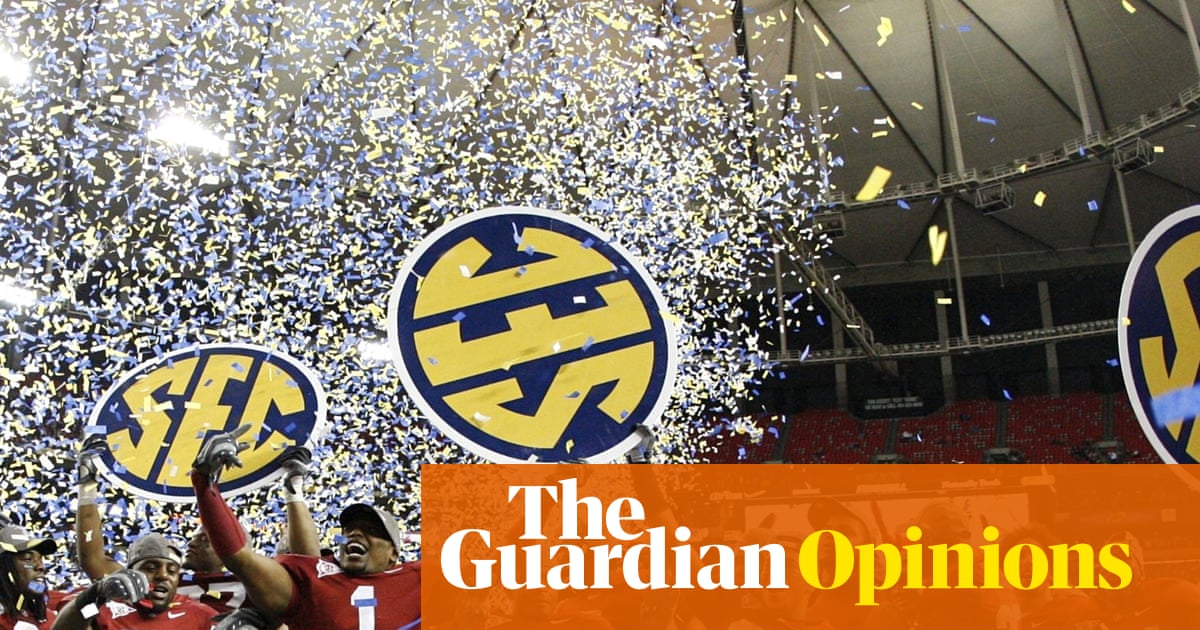
This week, the National Association for the Advancement of Colored People (NAACP) turned to sports, calling for Black athletes to boycott public universities in the Southeastern Conference (SEC), the most powerful football conference and a major incubator of Black athletic talent. The NAACP is responding with a social and economic strike against an institution central to southern culture.
The NAACP bets that Black Americans will recognize the urgency, that parents of gifted young athletes will realize their power. Black people are 14% of the population but far more of American culture; the Black athlete is the most successful and visible Black employee. A sustained, coordinated boycott would profoundly affect football fields, basketball courts, and politics.
The sports industry, if it sees any threat, bets on apathy and nihilism, hoping players feel powerless. Yet history shows boycotts work: in 2015, Black football players at the University of Missouri forced the president’s resignation; in the 1960s, an exodus of Black high school talent forced southern universities to integrate.
Black collegiate football and basketball players have more power today than ever, with name, image, and likeness (NIL) deals and the transfer portal allowing free movement. A boycott of the SEC—including Florida (whose governor banned books by Black authors), Louisiana (origin of the Voting Rights Act case), South Carolina, Alabama, Tennessee, and Texas—would have immediate impact. The NFL, whose workforce is 70% Black, recently awarded Tennessee the 2030 Super Bowl.
As in the 1960s, Black players could flex political muscle by moving to northern, midwestern, or west coast schools. NIL money combined with conscience and strategy represents a powerful response. The NAACP targets the SEC, but the Atlantic Coast Conference (ACC) also has schools in Florida, Virginia, North Carolina, and South Carolina.
We are in a pivotal moment. The Trump presidency draws focus, but broader institutions have exposed their racism through compliance. Sports carry sociopolitical weight only through the quest for equality, as shown by Jackie Robinson, Bill Russell, and Billie Jean King. The Black political voice in sports is essential to understanding the games, players, and country.
Over the past half-decade, sports media has willingly eliminated that voice, abnegating journalistic responsibility and muting athletes into neutered laborers for predominantly white audiences. While Trump is called racist, many editors who stifle the Black voice are equally culpable, especially in a sports business where the workforce is nearly three-quarters Black.
Sports media, responding to white audiences wanting uncomplicated entertainment, has engaged in a simplistic con. Black faces on television address “representation” but without depth or reportage on major national stories. ESPN responded to the NAACP boycott with a wire story that disappeared within a day; “athlete activism” feels as outdated as “groovy.”
It is in the interest of rights holders to convince Black athletes that their only value is to play and be grateful, reinforcing narratives that guarantee silence. The NAACP asks players and their parents to care about more than the bouncing ball.
The NAACP action is a reminder that Black athletes have power if they choose to use it. They are inextricably linked to the future of Black America through the economic profits they generate and their cultural cachet. As an economic bloc, they can shift institutional fortunes.
If one thing is certain, it is that there is plenty of money for sports in America. If Alabama or LSU can pay a wide receiver, so can Oregon, USC, or Michigan.
After a decade of activity in the 2010s, athletes have been largely silent politically since the George Floyd protests in 2020. They did not mobilize after January 6, even though the insurrection was backed by the same political base that condemned anthem protests. Players returned to playing, but anti-Blackness only intensified.
Nevertheless, players remain part of a Black athletic and civil rights heritage that laid down its life for comforts now being erased. A new generation is asked to pay their share. Why should they? Because they have received.
Howard Bryant is the author of 11 books, including “The Heritage: Black Athletes, A Divided America, and the Politics of Patriotism” and “Kings and Pawns: Jackie Robinson and Paul Robeson in America.”
📝 This article was rewritten with AI assistance based on content from The Guardian.
Related posts




Latest Post