
TRENDING

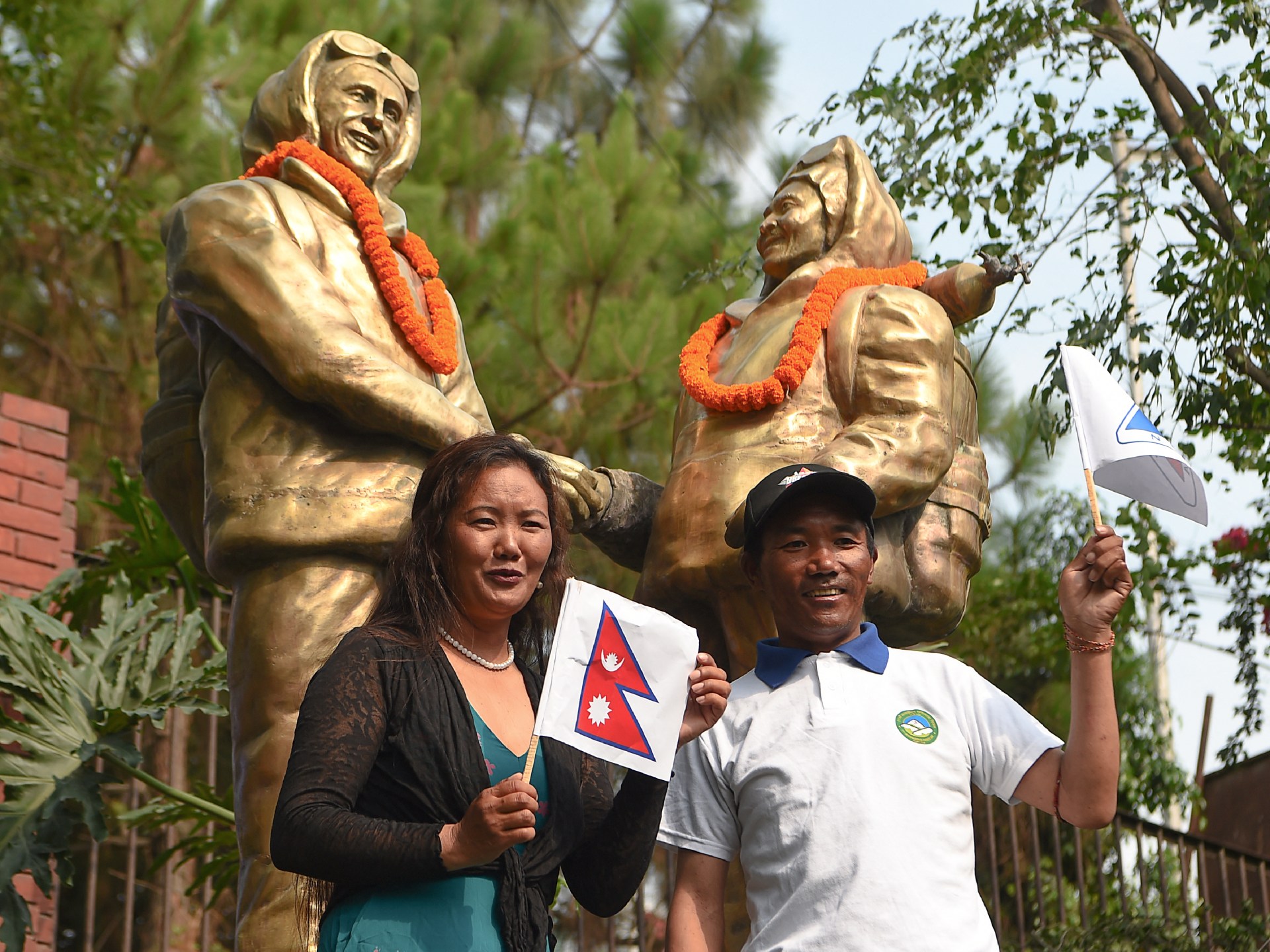
Two renowned Nepali guides have scaled Mount Everest, with one known as the “Everest Man” breaking his own record set last year by reaching the summit for the 32nd time, and another called the “Mountain Queen” surpassing her own women’s record with an 11th ascent.
“This is another milestone in Nepal’s mountaineering history,” Himal Gautam, spokesperson for Nepal’s Tourism Department, told the AFP news agency on Sunday.
Kami Rita Sherpa, 56, first stood atop the world’s highest mountain in 1994 while working for a commercial expedition. Since then, he has guided clients up Mount Everest almost every year, sometimes summiting twice in a single season.
Lhakpa Sherpa, 52, first reached the summit of Everest in 2000, becoming the first Nepali woman to successfully climb and descend the Himalayan peak.
“Their record gives greater excitement to other climbers,” Gautam said. “By breaking records through healthy competition on Everest will help make climbing safer, more dignified and better managed.”
In 2024, after another ascent of the 8,849-meter (29,032-foot) peak, Kami Rita said he was “just working” and did not intend to set records.
Kami Rita was born in Thame village in the Solukhumbu district, the same village as Tenzing Norgay, who with Edmund Hillary made the first ascent of Everest in 1953.
Since then, a climbing boom has turned mountaineering into a lucrative industry.
Nepal issued a record 492 Everest permits this year for the March-May climbing season. More than 8,000 people have climbed the mountain since Hillary and Norgay’s expedition, many of them multiple times.
Among non-Sherpa climbers, the record is held by British guide Kenton Cool, who has accomplished the feat 19 times, followed by American climbers Dave Hahn and Garrett Madison with 15 ascents each. Cool and Madison are currently on Everest aiming to improve their records.
The high number of climbers, along with their Sherpa guides expected to head for the summit in the coming days, has renewed concerns about overcrowding on the mountain, particularly if poor weather shortens the climbing window.
📝 This article was rewritten with AI assistance based on content from Al Jazeera English.
Related posts






Latest Post




