
TRENDING
US college graduates face tough job market amid economic uncertainty
8 minutes reading View : 48

World - 18 May 2026
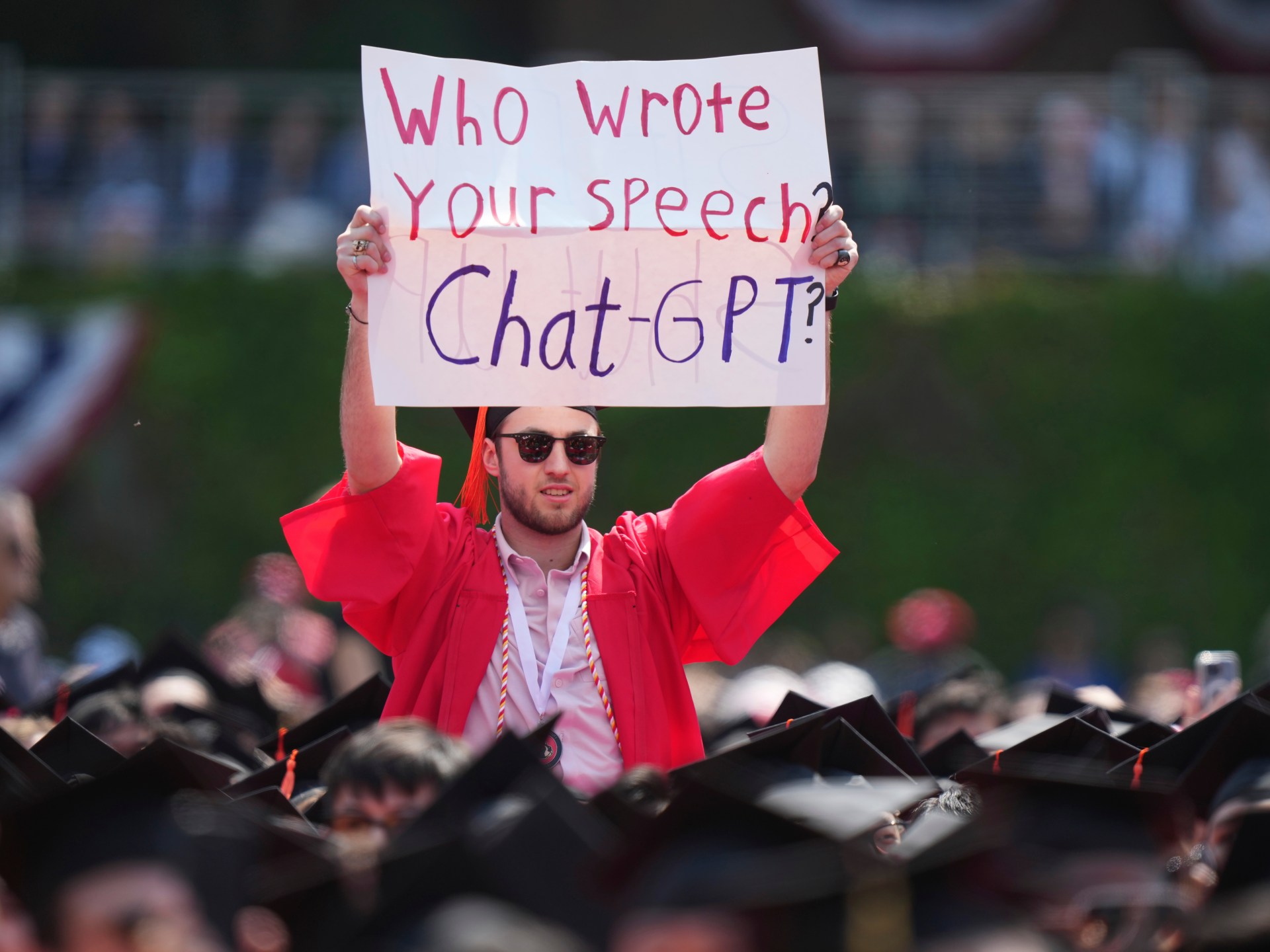
NEW YORK — Each May, soon-to-be college graduates gather in New York City’s Washington Square Park in caps and gowns, typically in purple, the school color of nearby New York University, for photographs marking the end of collegiate life and the onset of uncertainty about the future.
Julie Patel, who just completed a master’s degree in public health, was among those graduates, but a tight job market has dampened the celebration.
“I think expectations of when I came into this programme and coming out of it in terms of a job search, funding and what’s available are two very different things,” Patel told Al Jazeera.
Like millions of her peers nationwide, she faces a precarious job market amid surging economic uncertainty driven by tariffs, artificial intelligence proliferation, global conflicts and, in her case, government funding cuts that slow hiring — particularly for new graduates.
The most recent Job Openings and Labor Turnover Survey from the U.S. Bureau of Labor Statistics showed 6.9 million open jobs in March, with hirings rising marginally to 5.6 million and separations at 5.4 million, indicating that employed workers rarely leave their positions, leaving new graduates struggling.
“The depressed hires rate suggests that it is more difficult for new entrants to get a foothold in the labour market,” Elise Gould and Joe Fast wrote in an analysis by the Economic Policy Institute.
“The quits rate is down, signalling a reduction in the overall churn in the labour market as workers and employers sit tight through this period of economic uncertainty, likely related to chaotic policy decisions and implementation around tariffs, deportations, and the conflict with Iran.”
The latest jobs report showed the U.S. economy added 115,000 jobs, with growth concentrated in healthcare, transportation and retail.
However, other white-collar sectors weakened: financial activities lost 11,000 jobs, while information services shed 13,000; by comparison, the class of 2025 entered a market that added 177,000 jobs last year.
Overall, job growth has slowed sharply; so far in 2026, the economy has added an average of 68,000 jobs per month, compared with 49,000 in 2025, 186,000 in 2024, and 251,000 in 2023 — though the higher figures for 2023 and 2024 followed pandemic layoffs.
“We have this kind of no-hire, no-fire environment right now,” Aleksandar Tomic, associate dean for strategy, innovation, and technology at Boston College, told Al Jazeera.
“We don’t see as much labour turnover as we normally would, and with the layoffs, we now have more experienced workers looking for jobs who will probably elbow out recent college graduates.”
Government funding cuts have hit potential employers in public health, the sector where Patel seeks work.
Last spring, the Department of Government Efficiency — led by the world’s richest man, Elon Musk — slashed government programs and funds, including roughly $4 billion in research funds awarded by the National Institutes of Health, to reduce government waste.
Cuts to research funding have led universities across the United States to implement hiring freezes, including Duke University in North Carolina and Harvard University in Massachusetts.
Universities have continued to announce cuts; last month, the University of Maryland implemented a hiring freeze, and Princeton University cut jobs, affecting research positions that Patel and her classmate Molly Howard seek.
“We’re competing not only with our cohort, but also last year’s cohort and fighting with people whose jobs have been defunded, with more experience, and everything has also been extremely difficult,” Howard told Al Jazeera.
This comes as federal government cuts continue; the latest jobs report showed the federal workforce declined by 9,000 in April — down 348,000 since a peak in October 2024 — leaving those pursuing careers in public service, like Cathleen Jeanty, who is earning a master’s in international affairs from Columbia University, with fewer opportunities and increased competition for think tank roles.
New graduates also compete against current students for internships.
“I feel like I found myself competing for internships with people who are graduating, and then the people who are graduating are competing for jobs with people who lost their jobs due to funding cuts, the closure of USAID, the UN’s funding cuts, et cetera,” Jeanty said.
“It kind of feels like everyone is competing with people you would assume they would not be competing with.”
Artificial intelligence also weighs on the entry-level workforce.
There is a 16 percent decline in relative employment for early-career workers, including software engineers and customer service roles, while growth for more experienced workers remains stable, according to analysis from the Stanford Digital Economy Lab examining AI-exposed sectors.
“AI is really disrupting the entry-level job market. We’re seeing evidence of that. It’s doing two things: making it more difficult for entry-level candidates, while also increasing demand for more experienced workers,” Tomic said.
That trend is expected to tighten; a Goldman Sachs survey published earlier this month found AI advancements translate to an average of 16,000 jobs cut per month.
Anthropic CEO Dario Amodei has said several times over the last year that AI could eliminate half of entry-level white-collar jobs within five years.
Popularity of AI tools among Gen Z has declined in the last year; 22 percent of Gen Z respondents are excited about AI, down 14 percent from a year ago as they enter a more competitive market across age brackets, according to a Gallup survey.
“For the first time in decades, college graduates are coming into a labour market where they are competing against their peers, millennials, Gen X, and, in some cases, baby boomers who have recently been laid off due to the uptick in AI. In many instances, entry-level roles have been eliminated and fully replaced by AI,” Stephanie Alston, CEO of BGG Enterprises, a recruitment firm, told Al Jazeera.
New graduates also grapple with a job application process increasingly shaped by AI, making the barrier to entry even harder; AI-assisted resumes and the rise of fake applicants have strained hiring; consulting firm KPMG forecasts that by 2028, one in four job applicants will not even be real.
“I have had a few interviews, but if I have to be completely honest, in the last month, I have applied to 60 roles and my response rate is about 10 to 12 percent, and it’s frustrating,” Vivica D’Souza, who recently earned a master’s degree in media innovation and data communication from Northeastern University, told Al Jazeera.
With AI, some applicants now face AI recruiters before speaking to a real person.
Courtney Gladney, who just graduated from the historically Black college LeMoyne-Owen College in Memphis, Tennessee, with a bachelor’s degree in business administration, told Al Jazeera that he has been interviewed by AI personas.
Gladney was in the workforce before returning to school.
“We’re in that age of AI. So those are new things that companies are using,” Gladney said.
“I feel like sometimes it’s bad because I need the person in the interview to read me versus an algorithm.”
A difficult employment landscape is not new; in 2020, new graduates faced a stagnating market during the COVID-19 pandemic, and in 2008-2009, they entered during the Great Recession.
However, Tomic argues that in 2026, the U.S. economy tells drastically different stories for different people.
Turmoil during COVID hit the broader economy, while tariff pressures impact lower-income households more; for jobs, AI displacement has pressured less experienced roles and increased the premium on experience.
“The job market for experienced workers is very different from the one for those who are not experienced,” Tomic said.
“It [AI] has not affected experienced workers in the same way it has affected inexperienced workers. In fact, we’ve seen data showing that demand for experienced people has actually increased, while it has decreased for inexperienced workers, especially in jobs that are more prone to AI displacement.”
The unemployment rate among recent college graduates has surged twice over the last two decades: it reached 13.4 percent in June 2020, slightly above the general population’s 12.9 percent during the pandemic’s peak, and climbed to 7.1 percent in May 2010 after the Great Recession, though still below the general rate of 9.8 percent, according to the Federal Reserve Bank of New York.
It is now drastically lower at 5.6 percent, but still higher than the general population’s 4.2 percent.
Underemployment among recent college graduates has not fundamentally changed, standing at 41 percent now, compared with 43 percent a decade ago and 42 percent two decades ago, per Federal Reserve data.
That also means this is not uncharted territory for colleges.
“We have to tell students that this is not the first time we’ve been here. I mean, this is a part of the economic cycle. This is a lived reality. There are highs and there are lows in the economy,” Christopher Davis, president of LeMoyne-Owen College, said.
Davis stressed that while AI and political uncertainty present challenges, a focus on soft skills, such as in-person networking, will help students succeed.
“The degree may get you an interview, but it’s the soft skills that not only land you the job, but allow you to keep the job.”
📝 This article was rewritten with AI assistance based on content from Al Jazeera English.
Related posts





Latest Post




