
TRENDING

“html_content”: “
Drive north from New York City into the Hudson valley. Take Exit 17 and follow Route 7 south along the river, past the abandoned shipyard and the Cadet Motel. Hang a left, wind up a long driveway, and you’ll arrive at New York Military Academy.
The school is barely open now. Hundreds of students once attended; that number has dwindled to a few dozen. Most of the roughly 50 buildings on campus have fallen into disrepair, many seemingly abandoned. After dark, the place feels uneasy.
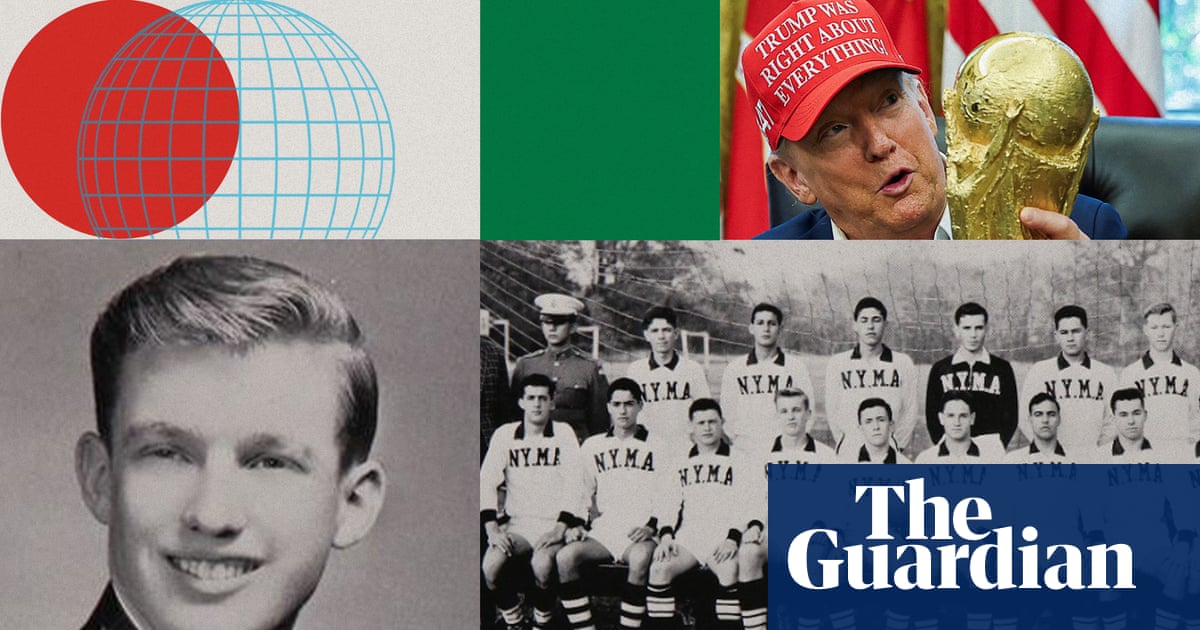
Further down the main drive, past boarded-up faculty housing, lies a forlorn soccer field. The school hasn’t fielded a team for years, but the field holds historical importance. On it, Donald Trump took some of his first steps toward becoming what some call the United States’ first ‘soccer president.’
Trump earned that label partly because he was in office in 2018 when the U.S., along with Canada and Mexico, won the 2026 World Cup bid. He will also be in office when the tournament kicks off this summer. He has welcomed club teams to the White House and presented the Club World Cup trophy to Chelsea last summer, awkwardly lingering on stage.
Cristiano Ronaldo, Wayne Rooney and Lionel Messi have all visited Trump. Messi was made into wallpaper while Trump ranted about the war in Iran. FIFA President Gianni Infantino at times seems glued to the U.S. president.
It’s debatable whether Trump truly cares about soccer or simply enjoys the attention. But it’s a fact that in 1963-64, his senior year at NYMA, Trump played on the school’s soccer team.
Peter Ticktin, a teammate who sometimes calls himself Trump’s ‘best friend’ at NYMA, describes Trump as a top player and makes an even bolder claim: ‘The year we were on the team together, we were 11-0,’ Ticktin told The Guardian.
This, to put it mildly, is subject to question. Trump himself once claimed to be a potential professional baseball player, but research showed his high school batting average was well below the Mendoza line.
Yearbooks and newspapers exist. Combing through them for clues about Trump’s playing career paints an interesting picture of his brief moment as a soccer player at NYMA and adds depth to arguably the most polarizing leader in U.S. history. Some accounts describe Trump as an incredible athlete; others are starkly different. Many describe him as a bully, a trait hardened amid NYMA’s culture of hazing and rigid discipline.
As for Ticktin’s claim? NYMA actually went 3-8 in 1964. The truth about Trump sometimes feels hard to find. Other times, it’s right there in the open.
The misadventures of Donald Trump’s early childhood have been well documented. Stories include him gluing his brother’s building blocks together and, in second grade, allegedly punching his music teacher in the face. By age 13, after seeing ‘West Side Story,’ Trump became fascinated with switchblades. His father Fred discovered a cache of knives in his son’s bedroom and shipped him off to military school.
The NYMA of the 1960s was entirely unlike today’s sleepy, near-abandoned campus. It had a well-documented culture of hazing and abuse akin to ‘Full Metal Jacket.’
‘The man who was the commandant of the junior school was a really narrow-minded martinet named Theodore Dobias,’ recalled Sandy McIntosh, a former classmate. ‘When Trump first arrived, Dobias told him to make his bed, and Trump said “screw you.” Dobias punched him out.’
Most instructors were hardened veterans, many having served overseas in World War II. They pitted students against each other, as Dobias did during twice-weekly ‘cage matches’ where one student would beat another into submission.
Dobias also coached football and baseball. Trump eventually learned to get on his good side. ‘I don’t think Trump ever played sports before military school, but he saw it as a way of getting in with this guy, which meant his survival, really,’ said McIntosh. ‘I never think of Trump as particularly intelligent, just wily.’
Trump’s exploits – or lack thereof – on the baseball diamond and gridiron are well documented because of those sports’ outsized place in American society. Soccer, especially during Trump’s NYMA days in the early 1960s, was almost fully marginalized. Trump’s claim that he could have gone pro as a baseball player is logistically plausible; he could never have done so as a soccer player because no genuine pro league existed.
There was, however, the Dutchess County Scholastic League, a collection of small schools scattered through the Hudson Valley and beyond. Trump joined its ranks in fall 1962, playing for NYMA’s soccer team after suffering an injury playing football.
Years earlier, NYMA had won the league under a British coach and his son, a star forward. By Trump’s arrival, the ‘booters,’ as the local paper called them, were coached by Col. Paul Curtin, who had far less soccer experience.
Curtin came to NYMA in 1962 after a decorated military career. During World War II, he had tracked through the Burmese jungle and flown resupply missions over the Himalayas. He later taught tactics at Harvard. That frontline experience did little to prepare him for the touchline.
‘Curtin didn’t know anything about soccer at all,’ recalled Alfred Harrison, a teammate of Trump’s.
Many players did, however. They had grown up with the sport. At the time, NYMA was a safe haven for well-connected military families from South and Central America. Figures like Cuban dictator Fulgencio Batista sent their children north for protection.
Yearbooks and newspaper clippings make clear that South and Central American kids – sons of officers and diplomats – formed the core of NYMA’s soccer team. The attacking line was Colombian and Venezuelan; the midfield was Mexican. Trump, who played full-back, was joined on the backline by Argentine and Peruvian cadets. As president, Trump has leveled racially charged insults at many of those same countries. As a member of the NYMA Knights, he was practically the only white player on the field.
Many former cadets recall racial tension at the academy and on its sports teams, though those memories often come with disclaimers like ‘it was a different time.’
‘Most everybody on the team called [the Latino kids] “spics,”‘ Harrison said. ‘But they called themselves that, too.’
‘We all called each other names,’ said Paul Curtin, the coach’s son and a team member. ‘It sounds awful today, and none of it was politically correct, but it was meant in fun. It was all part of the culture of the school, but no one was singled out.’
‘If you didn’t learn to speak Spanish, though,’ Harrison added, ‘you didn’t get the ball.’
Not long before joining the soccer team, Trump nearly got kicked out of NYMA. He had risen from private to sergeant to captain of an entire company by his senior year, but his time in that role was short-lived. During a dorm inspection, Trump found another cadet’s bed improperly made. He tore it apart, and the confrontation ended with Trump allegedly trying to throw the classmate out a second-floor window. It wasn’t Trump’s only violent incident.
‘One of these kids ended up in the hospital,’ McIntosh recalled. ‘His parents got on to it, and they threatened a big lawsuit. If it would have been anybody else, they’d have busted Trump to private or sergeant or put him away somewhere where people couldn’t see him.’
Instead, Trump retained his rank and was reassigned to a unit with no supervisory role.
Sixty years on, many of Trump’s soccer teammates recall the early roots of the cult of personality surrounding him today. On weekends, Harrison remembered, Trump’s parents always arrived with a young woman in tow – a rare sight at the all-boys academy. The school yearbook labeled Trump NYMA’s ‘ladies’ man,’ showing him walking arm in arm with his presumed girlfriend. But something was off.
‘Because she was the secretary at the school,’ Harrison said, laughing. ‘They just took that photo to make him look that way.’
Trump’s personality also drew followers. Harrison recalled serving Trump during his senior year as a waiter in the mess hall. ‘He always had the goon squad,’ Harrison said. ‘He would sit on the end, as the officers did, and ahead of him three rows down were these big, burly guys, like almost kind of a mafia thing.’
That goon squad might have fit well on the soccer pitch. In that era, matches were kick-and-run affairs dominated by long balls and defensive brutality. Harrison remembered playing a team from Monticello in the Catskills whose players wore bulky baseball catcher’s shin guards. ‘They were big and rough, and kind of plowed over everybody,’ Harrison said. ‘Most of the Spanish players were used to a higher level of play and not used at all to getting pushed around.’
Box scores for about half of NYMA’s matches can be found at the Newburgh Free Library. On microfiche, alongside articles about the space race and the Kennedy assassination, the 1963 season comes to life: NYMA struggled but wasn’t terrible. Playing matches with four 15-minute quarters, they kept games close and even beat Rhinebeck, the league’s best team.
Trump is listed as a full-back or half-back in box scores, though he sometimes wasn’t in the starting 11. NYMA’s backline gave up a little more than two goals per game.
Curtin, whose father coached Trump, recalled a conversation years after Trump left NYMA but well before he became president. ‘My father said that he was a good athlete and he was coachable,’ Curtin said. ‘He had a territory to cover and he did; he had responsibility to protect the goal and get the ball away. Given his limited exposure to soccer, he did well, apparently.’
‘On the soccer team, I would put him in the top 25% of the players,’ added Ticktin, the teammate who also claimed the team was undefeated.
Other former teammates describe seeing the early origins of Trump’s modern-day habits. ‘He called me “shoulders” all the time,’ Harrison said, referring to his rounded shoulders. ‘It was like the “Sleepy Joe” thing. He’s always been giving people those nicknames.’
Trump did not captain the team, as some reports have suggested. Javier Angel Sustaeta, a Mexican four-year letterman, captained the side.
Trump appears to have been an average player – understandable given his limited exposure to soccer. Perhaps the same bone spurs that allegedly kept him from being drafted into the U.S. military and sent to Vietnam also affected his play on the soccer field.
McIntosh had known Trump’s family since childhood; they belonged to the same beach club. When McIntosh arrived at NYMA, Trump’s father tasked Trump with looking after the new student. From under a green military tent, Trump regaled McIntosh with tales of military school over games of canasta.
‘He just delighted in telling me about all the hazing that went on,’ McIntosh said, ‘and all the things that I could expect – to be beaten up and so forth. He just seemed to enjoy that a lot.’
A few days before Trump’s graduation in 1964, the two walked around campus when Trump asked McIntosh a question: ‘He asked me if I’d remembered a certain baseball game he was in, and I did,’ McIntosh recalled. ‘He asked me to tell him about it. We were losing, the bases were loaded, and he was up at bat. And he hit this blooper that went over the third baseman’s head and fell behind him. That caused the fielders and shortstop to rush for the ball, some runners came in, and we won the game.’ Trump looked at McIntosh and paused. ‘No, I want you to remember this: I hit the ball out of the stadium, right?’ He made me repeat it back to him,’ McIntosh said, laughing.
Trump’s insistence on exaggeration makes things easy to debunk. There’s the box score from that game, but also the fact that NYMA never played at a stadium. The school didn’t even have an outfield wall to hit a home run over. Their baseball field barely had a backstop.
The depth of Trump’s interest in soccer is equally easy to unpack. After NYMA, Trump returned to New York City. About a decade later, he took an interest in Pelé and the New York Cosmos, eager to bask in the glitz and celebrity of the briefly popular team. In recent years, he was linked to unsuccessful bids to buy clubs in South America and the UK. His cozy relationship with Infantino led to the FIFA peace prize, just months before he ordered strikes on Iran. This July, he will present the World Cup trophy to the winners and will almost certainly play a role in the tournament news cycle.
Donald Trump was an average player on the field. More than half a century later, he has become a much bigger and more relevant player off it.
“,
“summary”: “A look at Donald Trump’s 1963-64 soccer career at New York Military Academy, where he was an average player on a losing team, amid hazing and bullying, with teammates recalling his early ego and exaggerations.”
}
📝 This article was rewritten with AI assistance based on content from The Guardian.
Related posts




Latest Post