
TRENDING
From child marriage escapee to first lady: Fatima Bio’s journey
8 minutes reading View : 41

World - 18 May 2026
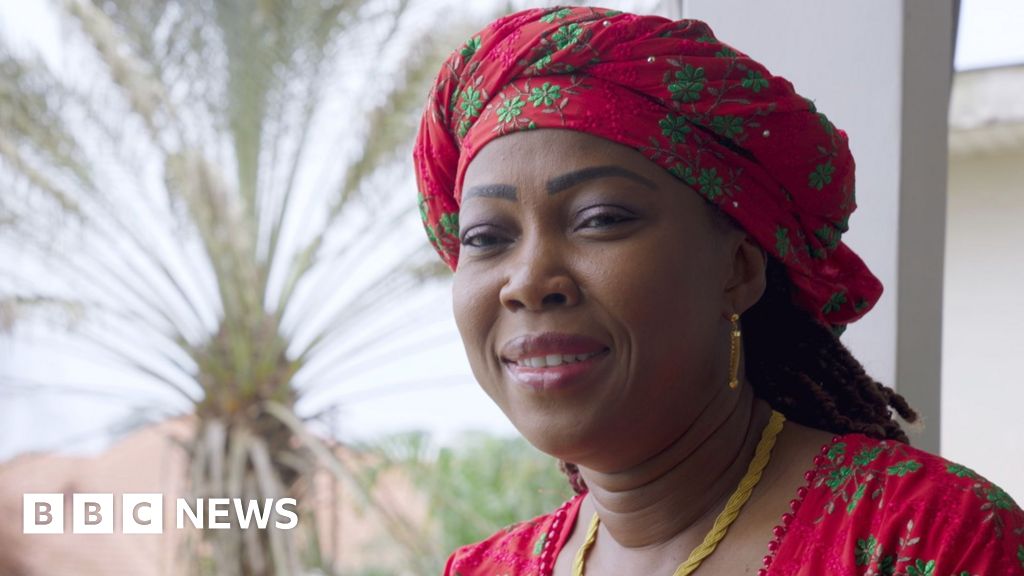
It takes Fatima Bio only a moment to respond when asked what it was like to be an asylum seeker in London.
“Better than being married to an old pervert,” she says deadpan, before laughing – a reference to her father’s plans to marry her off as a teenager.
Much has changed since then. She became an actress, then met a man in London while interviewing him about influential Sierra Leoneans in the diaspora and married him. That man was Julius Bio – now Sierra Leone’s president.
As the country’s first lady, Fatima Bio is seen as both compelling and divisive. Some young people view her as a refreshing political voice for women and girls, while others say she has overstepped her ceremonial role, becoming too vocal and too involved in her husband’s party.
She has been booed and jeered at by MPs and criticized over a video she shared on social media featuring a notorious drug dealer, whom she denies knowing.
She quickly composes herself to tell the story that inspired her to champion a law banning child marriage in Sierra Leone, which took effect in 2024.
She was nearly a child bride herself. By age 13, her father, a diamond miner from Kano district, had arranged her marriage to a man in his 30s whom she had known as an uncle figure since childhood.
“There was no discussion. It was decided,” she says.
But just before the wedding, when she turned 16 in 1996, Sierra Leone’s civil war created enough distraction for her to escape with relatives’ help and seek asylum in the UK.
Fatima Bio landed at Gatwick Airport on Christmas Eve wearing a T-shirt, shocked by the cold but relieved at the chance for a new life. She moved in with a distant relative.
“England was my amazing grace. I went to England, I got my voice,” the first lady adds. “I got my independence, and then I was able to fight for myself. And now I can fight for as many young people as possible.”
Another thing she gained in the UK was a council flat in Southwark, central London – a home she still keeps today where her children live.
As a form of social housing, council homes are usually cheaper to rent than private accommodation, and applicants must meet certain criteria.
The fact that a sitting first lady, who lives in a presidential mansion in Freetown, retains a tenancy has drawn criticism in both British and Sierra Leonean press.
With more than 18,000 people on the borough’s waiting list for housing, the council’s website says “even people in the greatest need can face several years’ wait.”
But she defends the situation. “My children are all British citizens,” she says. “I’m paying for my council house myself. I have not committed any crime.”
In a statement, Southwark Council told the BBC it does not comment on individual tenancies but “if there is doubt that tenants are meeting the obligations in their tenancy agreement, we carry out regular checks and investigations to determine that those obligations are being met.”
We are at the family’s farm, about an hour’s drive from the Presidential Lodge in Freetown, where she usually lives with her husband. Julius Bio, a former soldier, became president in 2018 and was re-elected in 2023.
At the farm, the first lady seems far more at ease than at formal functions. Wearing jeans and an Arsenal football shirt, she takes us to see her many animals, including chickens, cattle and goats.
This accessible, aspirational image – a fresh face for Sierra Leone, where international narratives have long centered on child soldiers, British colonial rule and blood diamonds – has won her millions of likes on social media. She posts regularly, often dancing and engaging directly with followers.
She addresses taboo topics such as period poverty. Sierra Leone has no national policy guaranteeing free sanitary products in schools – unlike Kenya, Botswana, South Africa and Zambia.
Groups, including UNICEF, have said girls in Sierra Leone often miss school during their periods for fear of dirtying their uniform.
“Girls were missing at least 80 days of school a year because of menstruation,” says Bio. “If you miss 80 days of the school year, it is almost like missing an entire term. They are still not getting the equality they deserve. That’s why I regularly visit areas to distribute free sanitary towels. I want girls to get the education so they can be at the table, making decisions for themselves.”
While this has won her supporters and saw her elected head of the Organization of African First Ladies for Development (Oaflad), many believe she is overstepping a role traditionally considered largely ceremonial.
She is an active member of the ruling SLPP party, openly championing favored politicians, and speaks at campaign rallies even when her husband is not present. She has also issued video statements on her own social media channels challenging politicians, including those in her own party, and the Speaker of Parliament.
During the State Opening of Parliament on August 7, 2025, Fatima Bio was booed by some MPs. Local media reported they sang a derogatory song about sex workers. She responded by putting on her earphones and listening to music.
The first lady insists the jeering did not upset her.
“It just shows that not all men are educated,” she says. “Not all men believe in women’s empowerment and women’s equality.”
“I have been an activist for far too long to be a calendar wife,” she says, explaining she does more than organize the family diary.
“I listen to the people and I bring it to the government. I listen to the government and I take it to the people. So that’s how we work.”
Over the days spent with her, Fatima Bio says she wants to refresh the image of her country.
At a graduation ceremony at Choithram International School, where she is the keynote speaker, girls stop to chat with her as they collect their diplomas. She notes that the first girls’ high school in sub-Saharan Africa was built in the country, and describes Sierra Leone as a place marked by religious tolerance.
Like 77% of Sierra Leone’s population, Bio is Muslim. Her husband, however, is among the 21% who are Christian. She says the couple attend both mosque and church services.
It was after a church service that she received some of her most intense criticism.
In January 2025, Reuters reported that Jos Leijdekkers, also known as “Chubby Jos,” one of Europe’s most wanted drug dealers, allegedly appeared on a video posted on First Lady Fatima Bio’s social media channels.
The footage allegedly shows Leijdekkers, 34, standing a few rows behind the first lady and the president at the church service.
Leijdekkers has been sentenced in absentia to 24 years in prison by a Rotterdam court for smuggling cocaine into the Netherlands. West African countries are often used as a route for drug trafficking from Latin America to Europe.
The BBC has not independently verified the video, which has now been deleted.
When asked by the BBC how one of Europe’s most wanted drug kingpins could get close to the first family, she denies knowing him.
“I wouldn’t know because I’m not a criminal,” she says. “I don’t bring people into church. I’m not a Christian. I’m a Muslim. So I don’t know who was in that church. You don’t talk about what you don’t know.”
She also denies rumors that Leijdekkers allegedly has a child with her step-daughter, the president’s daughter from a former relationship.
“These are all the lies I am not going to validate,” she says.
Analysts say most Sierra Leoneans are more concerned with the daily struggle to make ends meet than with thinking about Leijdekkers.
Ever since British geologists extracted diamonds in the 1930s, the country’s mineral wealth has rarely reached ordinary people.
A brutal civil war from 1991 to 2002, fueled partly by the diamond trade and backed by Charles Taylor’s forces in neighboring Liberia, killed tens of thousands and forced millions to flee their homes.
Recovery has been repeatedly set back – by the 2014 Ebola epidemic, Covid-19, and rising fuel and food prices after Russia’s invasion of Ukraine.
In 2022, protests over the cost of living broke out in Freetown and at least 20 civilians and six police officers were killed.
Against that backdrop, where daily economic pressures dominate public attention, other criticism of the first lady’s own wealth has surfaced, including over several properties. She refuses to be drawn when asked if her family occupy mansions in The Gambia, and how they were paid for.
“I don’t have to deny it. I don’t have to acknowledge it. When they come out with the proof that what they’re saying is the reality, then we’ll have a conversation.”
This confidence has many political analysts in Sierra Leone and beyond wondering if Bio is setting the stage to one day run for president herself – perhaps when her husband’s term ends in 2028, as he is not eligible to run again.
He too has faced controversy, including criticism over his management of the economy and questions about transparency in the 2023 election. The electoral body insisted mechanisms were in place to ensure a fair vote.
“I’m not hungry to be president,” says First Lady Fatima Bio. “It’ll have to be the will of God. I’m a very fervent believer that when God wants something, he does it… If it is what God wants, no man can stop it.”
📝 This article was rewritten with AI assistance based on content from BBC News.
Related posts



Latest Post




