
TRENDING
BJP wins historic West Bengal election, expanding Modi’s dominance
4 minutes reading View : 38

World - 18 May 2026
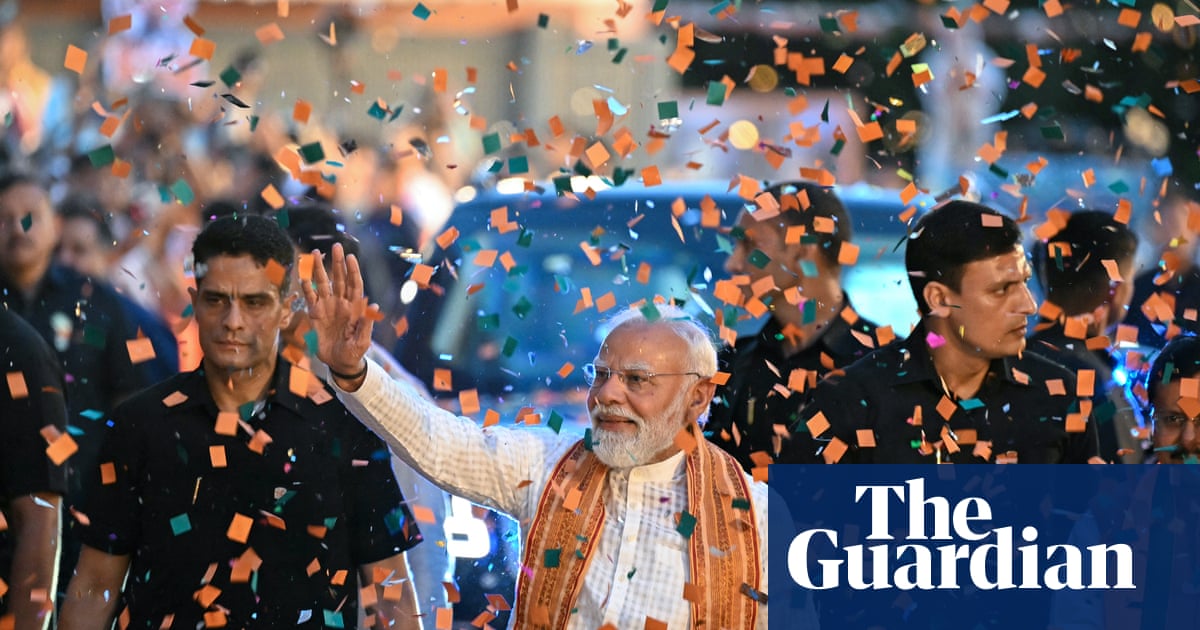
Narendra Modi’s Bharatiya Janata Party has secured a decisive election victory in West Bengal, a state that had long been a rare opposition stronghold, further consolidating the prime minister’s political power across India.
This marks the first time the BJP has won assembly elections in West Bengal, a large and politically significant state in eastern India.
For the past 15 years, the state was governed by the Trinamool Congress, a key opposition party led by Mamata Banerjee, one of Modi’s most vocal critics and a prominent female chief minister.
The BJP is projected to win more than 205 of the 294 seats in the West Bengal state assembly, a landslide that delivers a severe blow to an already fractured opposition and reshapes India’s political landscape.
Prime Minister Modi said in a statement: “The West Bengal assembly elections will be remembered forever. People’s power has prevailed and BJP’s politics of good governance has triumphed. I bow to each and every person of West Bengal.”
The victory in West Bengal, a long-standing BJP ambition, extends the Hindu nationalist party’s control over state and central governments, particularly expanding its influence in eastern India.
Since Modi became prime minister in 2014, the BJP’s political dominance and its agenda to transform India into a Hindu-majority nation have grown steadily, while the opposition remains weakened by internal divisions.
On Monday, the BJP also won re-election in the eastern state of Assam, giving the party control of 20 out of 28 states.
The victory followed a contentious revision of West Bengal’s electoral roll by the BJP government, a project called Special Intensive Revision that removed more than 2.7 million voters under the guise of purging illegal names.
Critics and TMC leaders alleged the SIR exercise disproportionately targeted Muslims and other minority groups who traditionally do not support the BJP, and many affected voters were unable to challenge their removal before the polls. The government denied any wrongdoing.
Rahul Verma, a fellow at the Centre for Policy Research in Delhi, described the BJP’s win as the culmination of a “seven-year project” by the party leadership and cadre.
Verma cited anti-incumbency and strong dissatisfaction with the TMC’s interference in daily life as critical factors that cost the party votes, adding that the BJP ran a smoother campaign than in previous years when it was criticized as “outsiders” threatening Bengali identity.
“The BJP had a strong and well organized presence in West Bengal and Modi is seen as a charismatic leader,” said Verma. “This kind of result also wouldn’t have happened without a consolidation of the Hindu vote.”
For Verma, while the SIR exercise likely did not swing the entire vote, it played “a marginal but still important role in these results.”
Monday’s victories in West Bengal, Assam and the small territory of Puducherry signal a return to the political momentum the BJP claimed before the 2024 general election, when it lost its outright parliamentary majority.
The results further weakened the Indian National Congress, the main opposition party, which faced additional losses and saw two of its allied parties removed from power.
“Looking back at 2024, it now seems like that was a temporary setback to BJP,” said Verma. “They are returned to their dominant position. With every successive defeat, there is much more pressure mounting on the opposition; while the BJP looks even more invincible.”
Analysts cautioned that the BJP could still face a volatile future amid mounting economic pressures from the Iran war and resulting energy crisis, as well as unresolved mass unemployment.
Monday’s results also underscored that southern India remains an opposition stronghold the BJP has yet to penetrate. In Kerala, the Congress party defeated the Communist-led alliance for the first time in a decade, while the BJP made small gains.
In a major electoral shock in Tamil Nadu, political newcomer and former film star C. Joseph Vijay and his Tamilaga Vettri Kazhagam party became the first new political group to gain power in the state in nearly 50 years.
📝 This article was rewritten with AI assistance based on content from The Guardian.
Related posts






Latest Post




