
TRENDING
US sanctions Hezbollah MPs, Lebanese officials to pressure disarmament
4 minutes reading View : 53

World - 22 May 2026
The United States has imposed sanctions on nine individuals it accuses of enabling Hezbollah to “undermine Lebanon’s sovereignty,” the latest effort to dismantle the group’s financial networks worldwide.
In a statement Thursday, the U.S. Treasury Department said the designations targeted those “for obstructing the peace process in Lebanon and impeding the disarmament” of Hezbollah.
The State Department said the sanctioned individuals include members of Lebanon’s parliament, an Iranian diplomat, and security officials in Lebanese government institutions who “abused” their positions.
“What this is saying is that if you’re in politics, business, or the security services – and you have been aiding Hezbollah and undermining the sovereignty of the Lebanese government – to think twice; there will be real consequences,” State Department spokesperson Tommy Pigott told Al Jazeera.
The nine include four Hezbollah members: Mohamed Abdel-Mottaleb Fanich, a leader in Hezbollah’s executive council; Nizammeddine Fadlallah, one of the group’s elected lawmakers; and longtime officials Ibrahim al-Moussawi and Hussein Al-Hajj Hassan, according to the Treasury.
Also on the list was Iranian ambassador-designate to Lebanon, Mohammad Reza Sheibani, and two security officials from the Hezbollah-allied Amal Movement, Ahmad Asaad Baalbaki and Ali Ahmad Safawi.
Two other security officials faced sanctions for allegedly sharing “important intelligence” with Hezbollah over the past year: Samir Hamadi, a branch chief with the Lebanese Armed Forces, and Khattar Nasser Eldin, a top official with the General Directorate for General Security.
U.S. officials also offered a reward of up to $10 million for information leading to the “disruption of the financial mechanisms” of the group.
Hezbollah said in a statement that the sanctions were an “attempt to intimidate the free Lebanese people” and would have “absolutely no practical effect on our strategic choices.”
“These sanctions serve as a badge of honor for those targeted by them, and as further confirmation of the validity of our chosen path,” the group added.
The latest round of sanctions comes as Israel continues to bombard Lebanon with shelling and airstrikes, despite a so-called ceasefire recently extended for 45 days.
Israeli airstrikes targeted multiple towns across southern Lebanon on Thursday, killing one person traveling by motorcycle in the Tyre district.
Israeli shelling was reported in the towns of Baraachit and Kfar Dounine, while a separate drone attack hit the town of Yaroun.
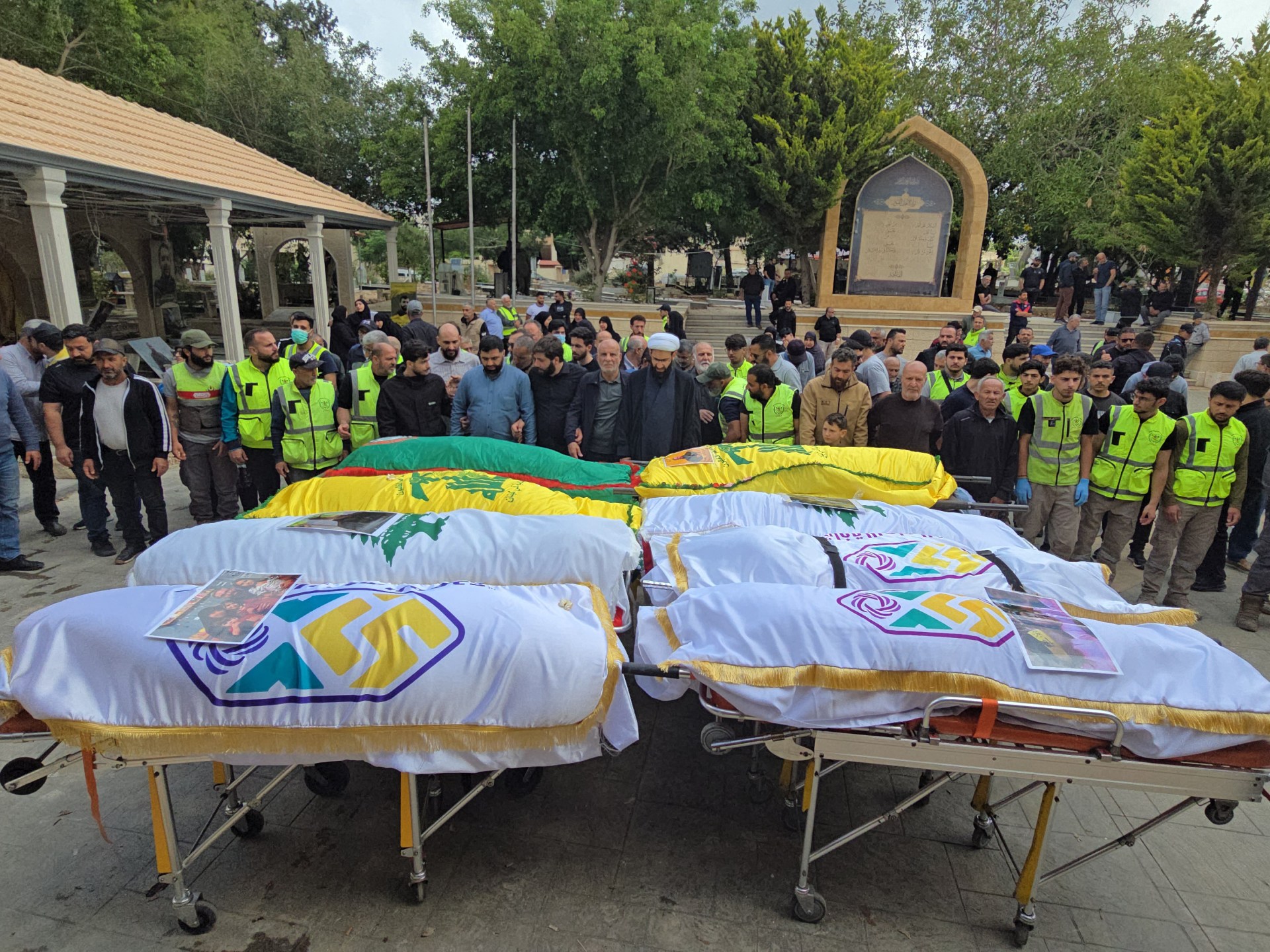
In the Tyre district, an entire family was laid to rest after an Israeli airstrike on the town of Deir Qanoun en-Nahr that killed at least 14 people Tuesday.
Hezbollah said it carried out a series of attacks targeting Israeli forces across southern Lebanon, including near Deir Siryan and Qouzah.
Lebanon’s Ministry of Public Health says Israeli attacks have killed at least 3,089 people and wounded at least 9,397 since March 2, when Israel resumed its war on the country.
The United States has been brokering peace talks between Israel and the Lebanese government.
Political negotiations are expected to resume June 2-3, while security-focused talks are scheduled for May 29 at the Pentagon between Israeli and Lebanese military representatives.
Al Jazeera’s Manuel Rapalo, reporting from Washington, said the sanctions are “part of a step-up” by the White House “to crack down on individuals they say are standing in the way of the disarmament of Hezbollah – that being one of the sticking points in the talks.”
Pigott told Al Jazeera that U.S. officials were “focused on creating the space for those good-faith conversations between the government of Lebanon and Israel.”
“What we’ve seen from Hezbollah is a direct effort to derail those conversations,” he added.
Hezbollah has repeatedly rejected the talks, which have spurred mixed feelings across Lebanon.
The group claimed the sanctions announcement intended to “intimidate our official security institutions” ahead of the next round of negotiations. “It is incumbent upon the Lebanese authorities to defend their constitutional, security, and military institutions,” it added. Still, in a statement Thursday, Lebanon’s army confirmed its “military delegation that will participate in the negotiations at the Pentagon” and is “committed to national principles and the army’s doctrine.”
📝 This article was rewritten with AI assistance based on content from Al Jazeera English.
Related posts


Latest Post